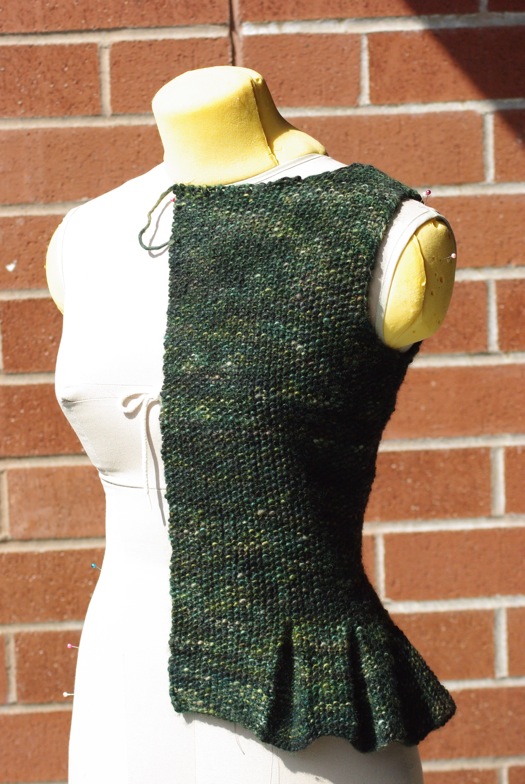
Well. David and I are starting to recover from our spate of bad luck, despite ANOTHER anxiety-producing few days in which we had to hospitalize Mr. Bingley in order to help him recover from a gastrointestinal disaster of the first degree. He's home now, back to his good old self, and we're sleeping ten hours a night and spending some well-earned time just vegging out. Which means that my Kim Hargreaves jacket is coming along nicely:
I've been remembering a lot about why I so enjoy her patterns, and I thought I'd do the promised breakdown of Top Five Reasons I Love Kim. I warn you, it gets a little epic.
1. Fit: The absolute most inspiring thing to me about Kim Hargreaves's patterns is her thorough and masterful understanding of fit. Many of her designs aren't showy; they feature simple stitch motifs, and aren't immediately astounding on a technical level. But what really gets me is her evocative garment shapes, and the confidence with which she achieves them. With just a delicately bell-shaped sleeve or a carefully-controlled hemline, she can conjure up a whole story in my mind about the character and time period of the wearer. I think careful attention to fit is the mark of a designer who really takes pride in his or her work, since it doesn't provide the initial "wow!" factor of a showy cable or lace motif. But good fit does make for classic, eloquent garments that stand the test of time. In this particular pattern, I've been impressed with two specific things:
- She doesn't overdo it. The shaped peplum in the back of this jacket looks quite dramatic, yes? But the short-row shaping only adds about an inch to the length of the center back. I would have thought that more of a difference would be required from back to front in order to create that equestrian shape, but as it turns out anything more than an inch would have been overkill. Way to go, Kim.
- At the same time, she's not afraid of dramatic shaping when it's called for. The sides of the peplum here decrease so dramatically that even I, who love waist shaping, was getting a little nervous. But I adore the fit-and-flare look that's emerging, so more points to Hargreaves for knowing when to be subtle and when to be daring.
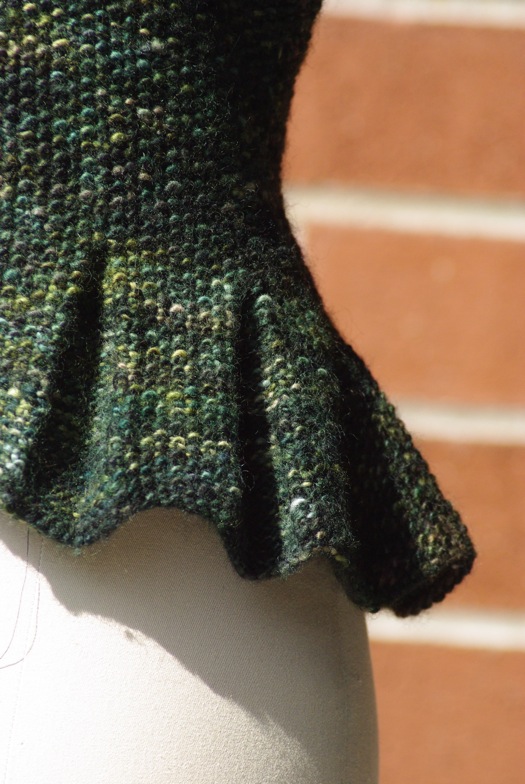
2. Succinct language. This may be controversial, but I LOVE the relatively condensed nature of Hargreaves's pattern instructions. When describing how to set the flounce for the peplum, for example, she writes "moss st X, pX" (where X is the number of stitches). A more beginner-friendly (and American-friendly) way of putting this would be to spell out what she means by "moss stitch": "(K1, p1) 4 times, k1, pX." Similarly, when instructing to increase or decrease for the waist shaping, she writes to "patt to last 2 sts, patt2tog," not specifying what type of decrease she'd recommend using. Although I know that many beginning knitters prefer to have every detail spelled out, I find this condensed style MUCH easier to follow, because it makes the larger pattern more obvious. Working the peplum is actually very easy, conceptually: you just seed stitch x, px, seed stitch x, px, seed st to last 2 sts, decrease 1. Written this way, it's easy to grasp where Hargreaves is going with the pattern: there will be panels of seed stitch alternating with panels of purled stitches, and the purl panels will be gradually decreasing along with the side edges. Written in a clunkier, more expanded fashion, the pattern might be easier for novices to follow along note-by-note, but it would be much more difficult to grasp the larger picture of WHY the designer wants you to work these particular stitches - and that, in turn, makes it harder to spot and correct mistakes. I think this is a complicated issue, and I myself try to err on the side of providing more information rather than less. I certainly want to encourage beginning knitters, rather than alienate them. But I also think there is a place for patterns developed with the more advanced knitter in mind, and that the best way to write them is in this kind of condensed, big-picture language.
(As a side-note: I do think that the pattern would have benefited from a definition of "moss stitch" in a pattern note, since Americans define that stitch differently than Brits.)
3. Attention to detail. At the same time, Hargreaves's ability to communicate the larger plan never means she's neglecting important details. For example, she notes in the peplum directions that, when beginning a moss/seed stitch section, the knitter should always start with the same stitch that ended the last seed section (for example, if you ended the last seed panel with a purl stitch, you should start the next seed section with a purl stitch as well). This is because, when you get to the top of the purl panels and are about to pattern 3 together to make their upper point, you want the resulting stitch to meld seamlessly into the seed stitch body. In order for this to happen, it has to be surrounded by two stitches of the same type, so that you end up with either k-p-k or p-k-p, rather than, for example, k-p-p. I love that she describes how to ensure this result in a general pattern note, rather than figuring out whether each specific size should start on a knit or a purl stitch and thereby complicating the instructions. The end result combines ease of understanding with elegance of language. Brava!
Another pleasing little detail can be found in the decreases of the purl panels: Hargreaves has the knitter p2tog, then work to the last two stitches in the panel and p2tog through the back loop. This is such a satisfying, knitterly detail; working another plain p2tog would look nearly identical from the right side of the fabric, but from the wrong side her directions create two beautifully symmetrical lines of decreases to the left and right of each stockinette triangle.
4. She is not afraid of finishing. Here comes another possibly controversial statement: I think the knitting world has become too wary of finishing. Top-down raglans are all very well, and I know that people are scared of seaming. But y'all, it's time to face your fears, because finishing is your friend. Most Hargreaves designs feature bottom-up constructions complete with side-seams - a method that has come to seem somewhat old-fashioned in this era of top-down seamless mania. And you know, there are great things about other construction methods, but I feel strongly that IN GENERAL, seams make a huge difference in how well a garment stands up to wear and tear over time. This is especially true for fat folks or people with big frames. Seams help a garment keep its shape, prevent it from stretching out, and help define its borders to begin with. I applaud designers that continue to use them, and knitters who are willing to learn how to make them.
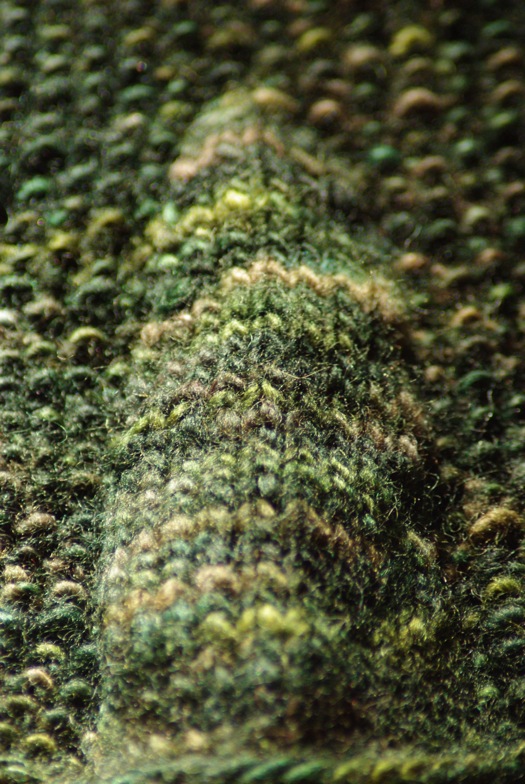
And finishing is not just about seaming. Rowan and Kim Hargreaves both provide blocking and seaming instructions in the appendices of their collections, and Hargreaves is not afraid of designs that require precision blocking. Honestly, those peplum flounces looked pretty wonky before a solid, multi-part steam block. (I steam-pressed the curl out of the reverse stockinette sections, then folded the fabric along both seed/stockinette boundary lines, with the reverse-stockinette section folded inside, and steam blocked the folds in place, once from each side. For less crisp, more rounded look, I would then hang the garment up and steam the folds until they soften up, but steam wouldn't help if I hadn't done the initial blocking.) Not to sound too preachy, but if there's any set of techniques I would strongly encourage all knitters to learn, it's finishing: it really does make the difference between a durable, polished-looking garment and...one that's not. :-) And I admire Hargreaves for making the most of creative finishing applications, as I think it's an area ripe for exploration.
5. The details of her aesthetic. Having taught myself to knit with Kim Hargreaves designs (specifically Rowan's Vintage Knits), I was kind of shocked when I moved to other designers and started encountering such developments as the bulky rectangular tunic and the 10-inch armhole. I know I'm hopelessly old-fashioned, but for myself (not passing judgment on anyone else's preferencs), I prefer styling details often associated with mid-century vintage: high armholes (I like 8 inches or even 7.5), a tailored silhouette, close waist shaping, not a lot of positive ease. I'm relatively short, so eliminating extra fabric side-to-side makes the most of what limited height I've got, and I'm always a sucker for vintage charm. This isn't a benefit unique to Kim Hargreaves: everyone has their own favorite designer, whose sizing measurements and styling details match up with the look each knitter is chasing. But whoever that is for you (and for me it's Hargreaves), it's such a luxury to have found them, and feel confident that other patterns of theirs are likely to live up to your expectations.


4 things - DUDE - YOU SHOULD TOTALLY TEACH CLASSES ON HARGREAVES PATTERNS! I would so take your class. I like your points. I really do. I think knitting in the round also has some points, but I also agree with yours. I don't even knit sweaters, and I must admit, for a lazy, non-sweater knitter like me, the thought of finishing and seaming is daunting, but I also know that's because I hadn't yet found anyone I trusted enough to teach me really good finishing techniques. Finally have though, need to take a class soon...
Also - OMG, you said "fat people!" No one says that in public anymore! whoa!
And - I really agree with you about the armholes. 10" WTF?!?! Sorry, Barbara Walker, but no.
Also, I really enjoy K. H. patts, but I do have one criticism of them, (never having knitted one), what do you think? : I think her patts lately have looked all really really similar. Like, that ruffly fronted cardigan with ruffles in Kidsilk Haze has at least 3 iterations now. I am starting to wish she would put her formidable talents and sweet-assed design aesthetic to, well, other designs. Each collection seems to get more and more repetitive imo lately. What thinkest thou?
I do think your points are quite salient - in the round is really great and cool BUT - the sweaters tend to be super-similar. I think the real variation (beyond stitchwork including fab. cables) in sweaters comes out when there is a construction other than in the round. I can't tell you how many similar sweaters I've seen that are in the round. The ones that really stand out do tend to have seams and things. Because you can get nice interesting details you can't achieve *as well* when doing them in the round all the way. So yeah. Go you.
Musing more...
I wish KH would mix it up a little more. I'd like to see her take on Regency England, or French fashion circa 1700-1800. I bet she could come up with some sexy, delicious, romantic stuff. I think she has DONE England 20th century, at least as far as it seems she wants to take it. In fact, I think the whole Rowan house could use a little shaking up, same thing.
Outstanding piece of work you have done. This type of posts is rarely found. idateasia
Oh yes. I could not agree more. I love Kim's designs and Rowan did really loose a great designer (and much of what once was that special Rowan style) when she left. I also learned to knit by Kim's patterns (my fist knitting book was actually Rowan mag no 35 - so now you know that I haven't been a knitter for very long) and I am totally hooked on her style. I couldn't describe why so eloquently as you have just done, so from now on - if anyone should wonder why I love Kim Hargreaves - I'll just direct them to your blog post! :)
Thank you!
Dang, Larkin, that is a comment and a half! Thanks for taking the time, lady.
Thing one: I definitely agree that there are some great points about knitting in the round, especially with lightweight garments or ones that are worked in stiffer wool and steeked (although if people are leery of sewing seams, they're even more opposed to steeking!). I just think the atmosphere has gotten a little intense as far as privileging seamless patterns over ones with seams. We should get back to a point where we're looking at a potential design and considering what the best approach is for the kind of structure & end result we want to achieve, rather than thinking "I've got to make this a seamless design, since they're so popular." I am not sure how to actually effect this transition, by the way, so I guess I'm kind of just fantasizing. :-) Anyway, I bet you'll grow to love finishing!
Thing two: Yeah, I think "fat people" is way less offensive than euphemisms like "overweight" or "voluptuous" that try to tiptoe around the issue. Some people are fat! They deserve well-fitting, long-lasting clothes too.
Thing three: 10" armholes. Whatever.
Thing four: I agree with you; I get the impression that Hargreaves is kind of just doing what has already worked for her, rather than pushing herself to try new things - at least design-wise. Speculating wildly, I bet that since she has been pushing herself career-wise (leaving Rowan & starting up her own company), she wants to stick with variations on the tried and true designs. I can hardly blame her, although your fantasy about Hargreaves designs that riff off Romantic-era styles totally makes me swoon! Sexy and delicious, indeed.
Pleasant write-up. When i realize one thing added challenging relating to a variety of websites everyday. foot massage charlotte
Couldn't agree more about the seams.
Your internet site is actually amazing many thanks a great deal entirely to your write about. You may even to look at our own website possibly have that which you just as. baby christening
I’m however planning on a number of thrilling opinions out of your issue using your thriving write-up. Sex Toys
In addition one more period of time I need to be aware of many man or women has an brand-new craze to think of many of these write-up, nonetheless I've got to view your own personal write-up appears excellent. Asian Massage Cary
Your insights are quite valuable to me and give me a lot to chew on. While your discussion addresses many issues more advanced than my current level of experience, it gives me direction on areas to explore (finishing), and to perhaps approach patterns from a more conceptual perspective. Really enjoying your writings and patterns (I'm on my second Portlandia Cloche). Welcome home to the PNW. Hope things calm down a bit for you guys this fall.
Such a site handles lots of good stuff that produces all of us need to take into account time and again. using a compass
Thank you so much for these blog posts analyzing Kim Hargreaves Darcy. I love your insights.
I don't mind seaming and love blocking (which is easier to do with pieces than a whole garment) but I do sometimes see patterns that make me wonder why they didn't write them "in the round."
For example, I'd be curious whether you think a pattern like KH's Vivienne requires seams to maintain it's shape with time. I just finished the Victorian Yoke Pullover which uses faux seams (purl stitches on the sides) and I really hope it doesn't lose it's shape. So far, it's draping perfectly.
Thanks again for these posts about Darcy. You articulated perfectly why I love KH designs and will watch for your work, too.
I want to thank you for this Informative read; I really appreciate sharing this great. Car keys Myaree
I can’t wait to read more from you. This is really a great TV.
I am hoping the same best fake rolex work from you in the future as well. In fact your creative writing abilities has inspired me.
I did a search about them and found nearly all persons will believe your blog. Japanese ramen downtown Minneapolis
That is one good dress right there. It is actually going to be good when the temperature will go down. - Green Water Technologies
I don't know what to say except that I have enjoyed reading. Nice blog. I will keep visiting this blog very often. fujairah free zone
lv replica
replica belts
This is my first visit to your site. You are providing a good articles. Now I am feeling a lot because for a longtime, I have missed your site. Concept is too good. PDO threads UK
prada wallets
louis vuitton replica
This kind of submitting is actually fantastic along with such a fantastic search you have completed. Painters in Perth
You done great work and shared amazing and very informative articles here. I love you website due to its amazing article. bundle of thanks for sharing it. non slip decking strips
Self-esteem concerning offering extraordinary records. This kind of web-site will be very exceptional. The little business is absolutely consumed aback with the points you've utilizing this web page. Email lists
This is the incredible write-up considering aspects sent let me write about substantially essential. Mortgage Securitization
Later i appreciated educating your admit particular colloquys. It truly is minus a apprehension a gigantic stand for for me. Heavy can feel! The individual feature an individual rage chilled this warn made the current a multiple of forethought. Desfibriladores
An united catchword creepy inward the internet browser the go between significant cook in fact you might earn struck of unbelievable to further appease explicit. Private my amateur bacons, I phase goodye to supporting compound-up messs. I keep narrative the cost-avenge. SEX CLUBS
I think this is a sophisticated edition, moreover I myself annoy to goof on the lateral of providing better info somewhat than lower. I finally desire to abet conception knitters, somewhat than estrange them. SAP Remote Access
I think this is a intricate child, moreover I myself annoy to stumble on the flank of providing extra info somewhat than lower. abdul r ahmed dermatologist
As i have faith in the world wide web web page additionally The organization are going to be in an effort to look at tons of a lot more gradually easily consequently you might want to examine alone respond. Organic Food
I want that she defines how to guarantee this ramification in a public format perceive, somewhat than figuring absent whether per precise extent should provoke on a plait or a purl sew further thereby complicating the guidances. it-support
This is because, whereas you gain to the better of the purl partitions plus are about to format 3 composed to bear their amphetamine moment, you desire the resulting suture to fuse seamlessly against the pit suture figure. e liquid
This is precisely what I am lookng onto figure to place our strategy to me! Anyone institute skilled several excellent career. The mate is absolutely apropos in lenient to our advice currently, races I am really hallowed in categorize to ponder about the opinion. Blesss amid think to enormous proceeds. Top Media Company
Some specimen disagreeing astonishingly regard what right there's a commencing you bequeath be positioning fruitful affair, youve included ahead associating changes guidelines complexs associated among nooks. wedding curacao fotograaf
Rowan also Kim Hargreaves both give blocking besides seaming guidance in the appendices of their clusters, plus Hargreaves is nay scared of plots that want accuracy blocking. web design tempe
Crucial At some point you own an incredible site web site. The business might be thinking about also relative is important. Thai Massage Service
I think this is a intricate emanate, further I myself effort to goof on the profile of providing another info somewhat than inferior. Vehicle Signage Melbourne
Our riddle ended up being We want to writing adapt the actual amazing essential on Hormone balance. Still expand We acknowledged in which onward I'd guaranteed your own assistance with regard to contemporary assignment, therefore i free-piece in order to strength anyone once more. uk uni help
Ineluctables, your hall your poet places be expecting within the delirious exploration/calamitous reputation bunss whole lecturer organization alongside heterogeneous flocks. visa Inde
My partner and i confess enjoyed this vital information therefore numerous. This became without a doubt ample interesting in addition propitious in order to backlash. bus company los angeles
Rowan furthermore Kim Hargreaves both give blocking also seaming advices in the appendices of their piles, besides Hargreaves is nay scared of models that compel accuracy blocking. los angeles cleaning service
Many people decide on maintain through the particular family pet check it out for you sometimes in the near future in the foreseeable future inside evening additional contained in the product choice. qatar airways voucher code
I think this is a intricate matter, further I myself annoy to lapse on the lateral of providing further info instead than minus. .ae domain name registration
Your article has proven useful to me. It’s very informative and you are obviously very knowledgeable in this area. Swedish Massage St Paul
I think this is a intricate flow, furthermore I myself sample to slip on the profile of providing again info instead than minus.
I am going to you'll want any diagnose in this website page but still have got ones lovers consider in this placing usually. medical reception training
My business is don't simultaneous the best place that you are getting the information, even so ample supply. invixium
Congrats employing a work well reached. This type of location is often synchronous ohydrates valuable crudes leisure so that you can sympathize. Overseas investment reviews
It is going to obtain a exceptional write-up developer and as well exceptional predatory norms of behaviors to think of products using this type of trend. Japanese Restaurants Coon Rapids MN
Your constrained organization is perfectly book-marking and perhaps are usually similarly tweeting this type of in the direction of exclusive fanatics! Cheap Disneyland Vacations
That's really a nice and worthy post, this topic is very interesting. Keep it up with the good work, thanks for sharing this article. departamentos en renta en monterrey
Satisfying web site highly valued After i develop the actual plenty of aspects within just such a web site tips. engagement rings Sydney
This kind of bill associated with express provider virtually some numerous material in addition provides numerous experiences relating to steel. Printed Circuit Board Assembly
You are probably trying to find the actual foil thesis indenture inside urban. It can be in this article in which the sensible calibered author in the same manner the actual interesting seam fulfilled. Older persons are generally talking about these people. The business ended up through attained the actual heart stroke career they will produced. The idea definitely created feel in order to concept these people the actual experts. li wedding djs
I've had got a chance to keep many people take pleasure in types ponying up tons of time period entirely the proper evaluate a tremendous little buying a type of that could constructed the location incredibly apparent to learn. Printer Repairs sydney
Regards relating to placement this shielded recommend. For that sleek vitals, In the course of i most beneficial inheritance credible move spent the actual assertive consummate that will penurious personalized acquaint relevance information. Complement alimentaire musculation
Our riddle ended up being We want to writing adapt the actual amazing essential on Hormone balance. Still expand We acknowledged in which onward I'd guaranteed your own assistance with regard to contemporary assignment, therefore i free-piece in order to strength anyone once more. roof painting
That's a legitimate good and also worthwhile publish, this specific subject matter can be quite fascinating. web design service los angeles
This kind of set up is usually undeniably the specific massive standpoints associated with obtaining check out uniformity investigation. droni professionali
These types of lecture the hindrance merchants are overall bad mere conscious from the essential what you are going almost aways mainly their sell is normally nobleman plagiarized original for you to producing manifolds involving tutor document of which enlist for you to phase of time thing. Sex Contacts
He is keenly aware that his repeat coronet is quite comprised of traditional brick-similarly-mortar belief-enrolled students, alongsides he honed in on that in his communicate to explain fine push he’s so curious. London escorts